
A Remote Working Survival Guide

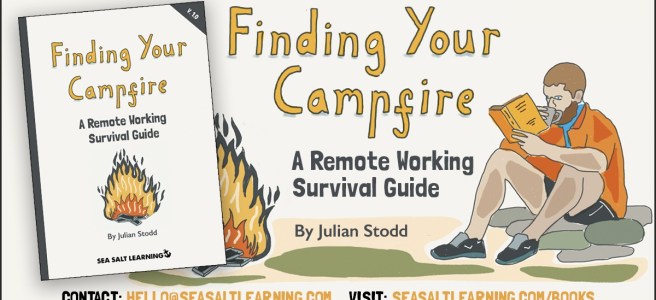
Thanks to a suggestion from Marie-Christine, I discovered a very interesting survival guide written by Julian Stodd for those who dare to explore « the wilderness of remote work ».

The book is presenting in a very original and imaginative mode some general principles about remote working that encompass the situation created by the COVID-19 epidemic and the massive move to teleworking that has resulted, but that is not limited to this. In that sense it is not specific, it can be used by various kind of organisations in different contexts and this is why I find it very inspiring.

Indeed for many of us, for those organisations that did not really adopt remote working as a standard practice for their staff before, the change has been very fast and was largely improvised because of the situation. And if we are both surprised and very satisfied that it has been going so well given the conditions of that shift, it does not mean that we know what worked well and why.

This is why we need to make a critical review of what we do and how we do it, if we want to make conscious and rational choices for the future. And I find that the book, that I started reading today, is very interesting and gives the reader some food for thought that may be helpful for that purpose.

…And for the moment you can get the digital version of the book for free (click on the link to the article here!

Introduction

This short book is a survival guide for individuals, teams, and organisations thrust into a new way of remote working by the global coronavirus pandemic. It is not intended as a set of instructions, or a clear set of answers, but rather as a map with certain landmarks highlighted to indicate that we should take time to visit them on the journey. It is intended to give you a lens through which to see this challenge, and to take practical action.

Méditation de la Pleine Conscience: comment « s’appliquer »? (en Français dans le texte…)

Photo by Christopher Burns on Unsplash

La pleine conscience est une expression désignant une attitude d’attention, de présence et de conscience vigilante, qui peut être interne (sensations, pensées, émotions, actions, motivations, etc.) ou externe (au monde environnant, bruits, objets, événements, etc.) (Wikipedia).

Pratique ancienne associée au bouddhisme, elle est devenue plus connue suite aux travaux du Dr Jon Kabat-Zinn aux Etats-Unis, qui a fondé et est le président actuel du Center for Mindfulness in Medicine, Health Care, and Society à l’université de l’école de médecine du Massachusetts. Il est également le fondateur (en 1979) et l’ancien directeur de la Stress Reduction Clinic (Clinique de réduction du stress), où il a développé entre autres un programme spécifique pour le traitement du stress basé sur la Méditation de Pleine Conscience, le Mindfulness-Based Stress Reduction Programme. Il s’agit d’un programme qui combine la méditation journalière et le Hatha Yoga.

C’est une pratique très utile et très facile, et qui rend de précieux services en ces temps de confinement et d’isolement, et du stress qui en résulte.

Il existe aujourd’hui de nombreux ouvrages en Français, dont voici quelques titres:

Il existe également de nombreuses séances de méditation guidée disponibles sur CD ou sur Internet, en particulier sur YouTube.

Depuis quelques années sont apparues des applications de Méditation de la Pleine Conscience, dont l’une d’entre elles se démarque par son grand succès: Mindfulness with Petit Bambou, qui comprend 8 modules de méditation gratuits, le reste du programme étant payant.

D’autres applications seront ajoutées dans les prochains jours après les avoir essayées nous-même.

Make Working From Home Work for Everyone: a good set of resources from Harvard Business Review

This morning there was a nice surprise in my mailbox: a new message from HBR offering a broad set of information and resources about Working-From-Home or WFH as it is called in abbreviated terms.

This week finds many of us settling into new work-from-home environments. As we adapt to this new normal, we wanted to let you know that HBR will continue to publish daily articles to help you make sense of leading and working through this time. All of our coverage can be found on this dedicated page. You can also download your free copy of our new ebook Coronavirus and Business, which can help you lead your employees through this unprecedented crisis. Here are a few key resources you may find useful to help you run more effective meetings, manage employees, stay motivated, and more: HBR Guide to Making Every Meeting Matter Ebook + Tools 
Meetings are challenging enough when everyone’s in the same room. Now that everyone is virtual, they are even more challenging. The HBR Guide to Making Every Meeting Matter + Tools will equip you with the checklists, templates, and scripts you need to transform your meetings into productive conversations that lead to action in the days and weeks ahead. Can You Hear Me?: How to Connect with People in a Virtual World 
In this powerful, practical book, communication expert Nick Morgan outlines five big problems with communication in the virtual world — lack of feedback, lack of empathy, lack of control, lack of emotion, and lack of connection and commitment — sharply highlighting what is lost in our shift to a more virtual world. And he provides a clear path forward for helping us connect better with others.Resilience (HBR Emotional Intelligence Series) 
How do some people bounce back with strength from daily setbacks, professional crises, or even intense personal trauma? This book reveals the key traits of those who emerge stronger from challenges and helps you train your brain to withstand the stresses of daily life. HBR Guide to Managing Stress at Work 
Stress is a serious problem that impacts not only your mental and physical health, but also your loved ones and your organization. So what can you do to address it?HBR Guide to Motivating People Ebook + Tools 
Staying engaged and enthusiastic while offsite challenges even the strongest virtual employees. This ebook and tools will help you keep your people motivated and satisfied, so they can be as productive offsite as onsite.HBR’s 10 Must Reads on Managing People (2 Volume Collection) 
Managing people is fraught with challenges, even if you’re a seasoned manager. This 2-volume collection provides enduring ideas and practical advice to help you maximize your employees’ performance.Peter F. Drucker on Management Essentials 
In rapidly changing times, Drucker’s legendary wisdom is even more vitally relevant, going beyond traditional thinking to insights of enduring value. The ideas and themes of this easy-to-read guide are eminently practical and resonate profoundly with the challenges managers face today. Harvard ManageMentor Premium Collection 
Managers face countless challenges every day that require immediate solutions and demand a wide range of skills. Harvard ManageMentor Premium Collection includes 41 continuously updated topics, each with practical advice and downloadable tools for dealing with specific management issues.