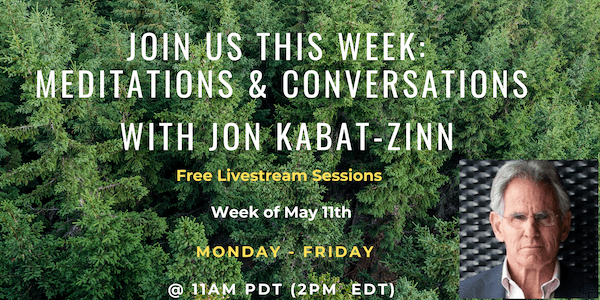
Today we are starting the 13th week of the COVID-19 retreat with Jon Kabat-Zinn, a long and fascinating mindfulness journey across the continents in the age of the coronavirus epidemic. A very special week indeed, as this will be the last of the retreat in its current form that will end on Friday 26 June.
You can join us live every day of this week at11 am PDT for livestreams by registering at the following url: http://wisdom2conference.com/live
The online Mindfulness retreat with Jon Kabat-Zinn has entered in its 7th week, providing a very useful and helpful window on here and now for anyone who is interested, or who is practicing mindfulness. It happens every week day at 7pm Lisbon Time, (8pm Paris or Brussels Time).
Two special features make this online retreat unique: the Q & A session with Jon after the guided meditation, and the community conversations that take place in the second hour on Tuesdays and Thursdays.
The Zoom connection allows for an audience of up to 1000 persons, if it is full when you connect, you can follow the session live on YouTube (see links on this page). You do not need to be already familiar with Mindfulness to try and to attend, this is an open retreat.
See hereunder the announcement and the instructions for connection. If you miss a session, you can watch it on YouTube on the webpage of the organisers.
Dear Friends,
We do not know how long these sessions will last, but we are so happy to continue them for the foreseeable future!
Join us each weekday at 11am PDT. This week we have the same links as last week. I have included them below. These are completely free, and you are welcome to invite invite friends and colleagues.
I have discovered QI Gong and Tai Chi Chuan some 15 years ago in Lisbon, thanks to a small association called Academia de Artes Orientais. In the beginning of every lesson of Tai Chi, there was first a session of Qi Gong, and one of the key features was the practice of the « Eight pieces of brocade ». As the best moment for practice was the morning lesson, I discovered and enjoyed the benefits of a regular practice in the early morning. Then we moved our offices to another location in the city and it became more difficult for me to continue the practice, and I stopped until I rediscovered it some months ago.
The Eight Pieces of Brocade is an Ancient Chinese exercise & fitness Practice. It is a popular form of Qi Gong, also known as Ba Duan Jin. It originated during the South Song Dynasty nearly 1000 years ago and it offers practices that are accessible for everyone, regardless of age or physical condition. In general, the first practices that students generally learn about are relaxation.
A few weeks ago, I discovered a fantastic video of 40 minutes of Qi Gong on YouTube that I have shared with you in a previous post, and that I follow 2-3 times a week. Today, I would like to share with you a shorter exercise, covering the Eight Pieces of Brocade that will take you only 20 minutes if the other one seems too long for you.
As you can see, there is no age for the practice of Qi Gong, I hope that like me you will appreciate the slow pace of the series of exercises and that it will help you to start well your day.
La pleine conscience est une expression désignant une attitude d’attention, de présence et de conscience vigilante, qui peut être interne (sensations, pensées, émotions, actions, motivations, etc.) ou externe (au monde environnant, bruits, objets, événements, etc.) (Wikipedia).
Pratique ancienne associée au bouddhisme, elle est devenue plus connue suite aux travaux du Dr Jon Kabat-Zinn aux Etats-Unis, qui a fondé et est le président actuel du Center for Mindfulness in Medicine, Health Care, and Society à l’université de l’école de médecine du Massachusetts. Il est également le fondateur (en 1979) et l’ancien directeur de la Stress Reduction Clinic (Clinique de réduction du stress), où il a développé entre autres un programme spécifique pour le traitement du stress basé sur la Méditation de Pleine Conscience, le Mindfulness-Based Stress Reduction Programme. Il s’agit d’un programme qui combine la méditation journalière et le Hatha Yoga.
C’est une pratique très utile et très facile, et qui rend de précieux services en ces temps de confinement et d’isolement, et du stress qui en résulte.
Il existe aujourd’hui de nombreux ouvrages en Français, dont voici quelques titres:
Il existe également de nombreuses séances de méditation guidée disponibles sur CD ou sur Internet, en particulier sur YouTube.
Depuis quelques années sont apparues des applications de Méditation de la Pleine Conscience, dont l’une d’entre elles se démarque par son grand succès: Mindfulness with Petit Bambou, qui comprend 8 modules de méditation gratuits, le reste du programme étant payant.
D’autres applications seront ajoutées dans les prochains jours après les avoir essayées nous-même.





 Broebelghem