« The time is now, so go out and live it! »

There has been a long time since the last time that I shared something on this blog, a bit more than one year.
Since then, we have jumped from one COVID-19 lockdown to another, from crisis management to chaos management, social life to Zoom meetings, and team spirit to empty buildings.
After too many months of pandemic and protective measures, we have lost the sense of togetherness; we learned to avoid hugging or kissing those we love the most and avoid proximity to other human beings.
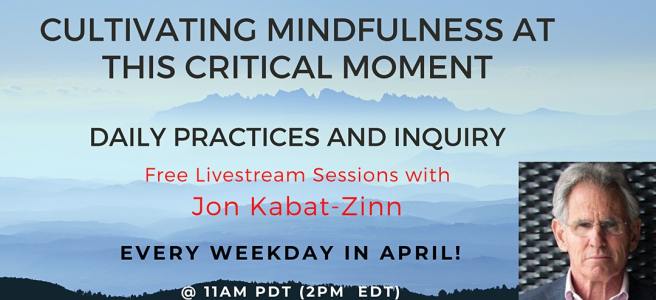
And still, we have managed to overcome our fears and our anxiety, and we have built resilience. We are now experts in using masks, disinfectants, and videoconferencing, poking harms, not hands. We have replaced many on-site activities with online gatherings; we started new yoga or Pilates lessons. We have been so lucky to follow the Mindfulness Retreat with Jon Kabat-Zinn every day for so many weeks with so many people worldwide (on the first evening, we were more than 20.000!).
We have become more productive, exaggeratedly productive sometimes, at least for those who could keep their jobs.
We have applauded nurses and doctors every Friday evening on our balcony, and we sometimes had a feeling of belonging to something bigger than ourselves.
There have been many examples of solidarity and compassion with our fellow human beings, and there are plenty of stories that prove that one reveals itself in challenging situations.
We also had a lot of fun, even during the lockdown and during each episode of partly recovered freedom.

Life has continued, although not for everybody, but it is not like before. For the young and the elderly, there has been a vital life deficit: the former lost the beginning of their life, and the latter faced an end of life in complete isolation. The pandemic affected both our becoming and our remaining humans.

We need time to imagine and understand what will be our new way of life post-COVID. We need to heal and celebrate life; we need to reconnect with our part of humanity, individually and collectively.

Listen to the testimony of Elin Kjos on a TedX and to her conclusion: « The question is « how do we choose to live our lives while we are still here? Don’t wait anymore, not for a second. The time is now, so go out and live it! ».

Spring is coming.

Winter is already gone. It depends on each of us to let Spring and Summer come in our hearts.

Photo by Mauricio Santanna on Unsplash

Mindfulness COVID-19 Retreat with Jon Kabat-Zinn: last week 22-26 June 2020!

Today we are starting the 13th week of the COVID-19 retreat with Jon Kabat-Zinn, a long and fascinating mindfulness journey across the continents in the age of the coronavirus epidemic. A very special week indeed, as this will be the last of the retreat in its current form that will end on Friday 26 June.

You can join us live every day of this week at11 am PDT for livestreams by registering at the following url: http://wisdom2conference.com/live

Photo by Anton Repponen on Unsplash

Between tragedies and statistics

I have found a very interesting analysis about the use of epidemiology and modelling for policy making in an article from The Economist published on Apr 4 with the title « The hard choices Covid policy makers face ».

This article is a good example of the importance to escape to the « noise » created by a maelström of messages, comments, opinions, true and fake data and other pseudo scientific evidence that come out of the media and from Internet. In those Covid-19 days, especially while being in lockdown during already 8 weeks, the most difficult is to avoid to be absorbed by such a flow that is highly unstable and unreliable, and that conveys contradictory messages that can only lead to a depressive state of mind and a feeling of absolute despair.

A significant part of this negative flow relates to « exit » or « Post-Covid » strategies, to the possible future waves (are we going for a second or a third one, is it going to happen in June, in the Summer, in the Autumn, etc.). But it does so in a way that does not bring any reflection, nor any orientation to figure out what are the key questions. In such condition it does not come as a surprise to see that the main result is an increase of the confusion about how to think our future. Therefore every time that I will find a paper, an article or a report that brings some food for thought, I will share it with you on this blog.

Why this briefing in particular? I find that it puts into perspective statistical modelling, other methods and approaches and their respective limitations, both from epidemiology and economics.

Qi Gong: Eight pieces of brocade

I have discovered QI Gong and Tai Chi Chuan some 15 years ago in Lisbon, thanks to a small association called Academia de Artes Orientais. In the beginning of every lesson of Tai Chi, there was first a session of Qi Gong, and one of the key features was the practice of the « Eight pieces of brocade ». As the best moment for practice was the morning lesson, I discovered and enjoyed the benefits of a regular practice in the early morning. Then we moved our offices to another location in the city and it became more difficult for me to continue the practice, and I stopped until I rediscovered it some months ago.

The Eight Pieces of Brocade is an Ancient Chinese exercise & fitness Practice.  It is a popular form of Qi Gong, also known as Ba Duan Jin. It originated during the South Song Dynasty nearly 1000 years ago and it offers practices that are accessible for everyone, regardless of age or physical condition. In general, the first practices that students generally learn about are relaxation.

A few weeks ago, I discovered a fantastic video of 40 minutes of Qi Gong on YouTube that I have shared with you in a previous post, and that I follow 2-3 times a week. Today, I would like to share with you a shorter exercise, covering the Eight Pieces of Brocade that will take you only 20 minutes if the other one seems too long for you.

As you can see, there is no age for the practice of Qi Gong, I hope that like me you will appreciate the slow pace of the series of exercises and that it will help you to start well your day.

Leadership and teleworking

Two months ago, if someone had told us that the entire organisation would be working from home, would be connected all the day long to the servers, and would be having only online teleconference, nobody would have believed it. And we would not have believed neither that the system would be sustainable and would keep running without any crashdown (so far!).

For a small organisation used to work more or less the same way for 25 years, it has represented a big challenge in terms of work organisation, ICT systems and services, and Human Resources management. And every day that passes surprises me how easy it has been to make such a giant leap as there was no alternative, and as all energies have been used to accommodate the change in the best possible way.

If I want to identify what factors have been the most important so far, I would highlight three: good crisis management, accelerated preparedness for ICT systems, and a lot of time and energy dedicated to the human factor.

We may come back to some of those issues later, but I wanted to share with you a very interesting and useful resources developed by Business Insider, called « LEADING FROM HOME: Every guide a manager needs to lead their remote team to success ». It covers 15 topics that are not necessarily relevant for your specific company, but they provide a very good and very inspiring overview. I wish you enjoy and find as inspiring as I did! https://www.businessinsider.com/every-guide-manager-needs-lead-remote-team-to-success

Action for Happiness: April Calendar

Paula shared with us an interesting resource, a Calendar for Happiness which « has daily actions for April 2020 to help us look after ourselves and each other as we face this global crisis together. »

In her message, Paula comments the quote from Frankl that appears on the top of the calendar:

« I would like to end this email focusing on the quote of this month calendar by Vitor Frankl, an Austrian neurologist and psychiatrist as well as a Holocaust survivor. He wrote in his book ‘Man’s searching for a meaning’ (1946; 2006):“Everything can be taken from a man but one thing: the last of the human freedoms — to choose one’s attitude in any given set of circumstances, to choose one’s own way.” For Frankl, meaning came from three possible sources: purposeful work, love, and courage in the face of difficulty. »

https://www.actionforhappiness.org/active-april

MINDFULNESS with Jon Kabat-Zinn everyday this week!

Dear Friends, 
 
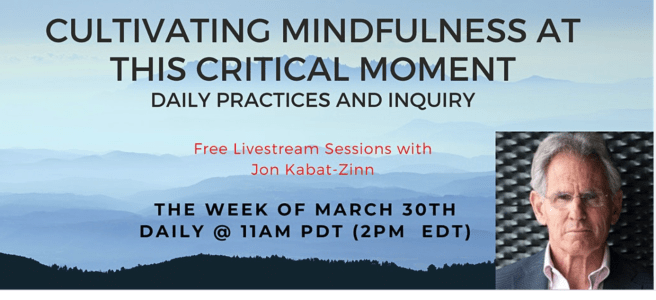
Please join us with Jon Kabat-Zinn this week of March 30th! Starting today.

Details:
 Time: 11 AM PDT (2 PM EDT) When: Daily Monday – Friday, March 30th – April 3rd Ways to Join:

Via Zoom: https://zoom.us/j/427188578 (Limited to the first 1,000 people) Join Online: www.wisdom2conference.com/live (No limit)

Have friends who want to join? They can register here.

Start well the day with a Qi Gong session on YouTube

« Immuni Qi » Qigong Routine for Lungs and Immune System – with Jeffrey Chand

What is Qigong?

Qigong (pronounced chee-gong) is an ancient Chinese exercise and healing technique that involves meditation, controlled breathing and movement exercises. For more info look for instance at this post of Elisabeth Palermo on Live Science: https://www.livescience.com/38192-qigong.html

This video is very good, it offers a good session of 40 minutes basic Qi Gong practice that is particularly helpful in the morning while starting your day. Please do not hesitate to share with us other links.

Broebelghem, jour 1

Cela faisait longtemps que j’y pensais, j’étais à la recherche d’un espace moins envahissant et envahi que les réseaux sociaux et leur buzz permanent. Je souhaitais également quelque chose de moins « exposé », et pas institutionnel.

Entre-temps le coronavirus est passé par là, et au bureau nous avons tous basculé en télétravail, avec ses nouvelles règles, ses nouvelles contraintes et ses nouvelles opportunités. Avec de nouveaux besoins aussi, par exemple partager avec les collaborateurs des ressources sur « La vie aux temps du COVID-19 », pour paraphraser Gabriel Garcia Marquez. Et donc le besoin de partager est devenu plus fort, et un peu plus pressant.

Et finalement nous y voilà, le blog est créé, il est donc temps de se lancer.

Quel est l’objectif ?

  • Partager des ressources et des idées sur différents sujets liés au développement personnel et professionnel, la transformation digitale, des articles intéressants, des liens vers des vidéos ou des sessions en ligne;
  • Et au-delà, prendre un peu le temps de respirer, contribuer à réfléchir sur l’impact de ces changements sur la vie de l’après-COVID-19 ou de l’après-Brexit, dans un mode réflexif et apolitique.

J’espère que vous apprécierez et que vous vous joindrez à moi pour un tour!

Broebelghem, day 1

I had been thinking about it for a long time, I was looking for a less invasive and invaded space than social networks and their permanent buzz. I also wanted something less « exposed » and not institutional.

In the meantime the coronavirus has passed by, and in the office we have all switched to teleworking, with its new rules, its new constraints and its new opportunities. With new needs as well, for example sharing resources with collaborators on « Life in the times of COVID-19 », to paraphrase Gabriel Garcia Marquez. And so the need to share has become stronger, and a little more pressing.

And finally here we are, the blog is created, so it’s time to get started.

What’s the objective?

  • To share resources and ideas on different topics related to personal and professional development, digital transformation, interesting articles, links to videos or online sessions;
  • And beyond that, to take some time to breathe, to contribute to reflect on the impact of these changes on life in the post-COVID-19 or post-Brexit era, in a reflexive and non-political way.

I hope that you will enjoy and that you will join me for a ride!

Translated with http://www.DeepL.com/Translator (free version)