« The time is now, so go out and live it! »

There has been a long time since the last time that I shared something on this blog, a bit more than one year.
Since then, we have jumped from one COVID-19 lockdown to another, from crisis management to chaos management, social life to Zoom meetings, and team spirit to empty buildings.
After too many months of pandemic and protective measures, we have lost the sense of togetherness; we learned to avoid hugging or kissing those we love the most and avoid proximity to other human beings.
And still, we have managed to overcome our fears and our anxiety, and we have built resilience. We are now experts in using masks, disinfectants, and videoconferencing, poking harms, not hands. We have replaced many on-site activities with online gatherings; we started new yoga or Pilates lessons. We have been so lucky to follow the Mindfulness Retreat with Jon Kabat-Zinn every day for so many weeks with so many people worldwide (on the first evening, we were more than 20.000!).
We have become more productive, exaggeratedly productive sometimes, at least for those who could keep their jobs.
We have applauded nurses and doctors every Friday evening on our balcony, and we sometimes had a feeling of belonging to something bigger than ourselves.
There have been many examples of solidarity and compassion with our fellow human beings, and there are plenty of stories that prove that one reveals itself in challenging situations.
We also had a lot of fun, even during the lockdown and during each episode of partly recovered freedom.

Life has continued, although not for everybody, but it is not like before. For the young and the elderly, there has been a vital life deficit: the former lost the beginning of their life, and the latter faced an end of life in complete isolation. The pandemic affected both our becoming and our remaining humans.

We need time to imagine and understand what will be our new way of life post-COVID. We need to heal and celebrate life; we need to reconnect with our part of humanity, individually and collectively.

Listen to the testimony of Elin Kjos on a TedX and to her conclusion: « The question is « how do we choose to live our lives while we are still here? Don’t wait anymore, not for a second. The time is now, so go out and live it! ».

Spring is coming.

Winter is already gone. It depends on each of us to let Spring and Summer come in our hearts.

Photo by Mauricio Santanna on Unsplash
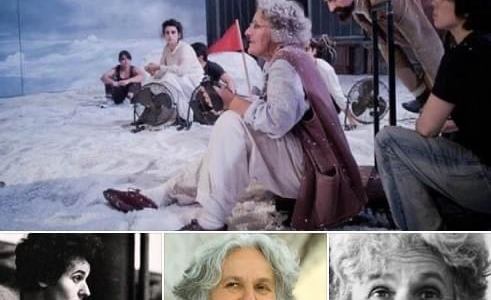
…disons à nos enfants qu’ils arrivent sur terre quasiment au début d’une histoire et non pas à sa fin désenchantée…

Ariane Mnouchkine, 82 ans

« Il faut fuir l’incrédulité ricanante, enflée de sa propre importance, fuir les triomphants prophètes de l’échec inévitable, fuir les pleureurs et vestales d’un passé avorté à jamais et barrant tout futur.
Et surtout, surtout, disons à nos enfants qu’ils arrivent sur terre quasiment au début d’une histoire et non pas à sa fin désenchantée. Ils en sont encore aux tout premiers chapitres d’une longue et fabuleuse épopée dont ils seront, non pas les rouages muets, mais au contraire, les inévitables auteurs.

Il faut qu’ils sachent que, ô merveille, ils ont une œuvre, faite de mille œuvres, à accomplir, ensemble, avec leurs enfants et les enfants de leurs enfants.

Disons-le, haut et fort, car, beaucoup d’entre eux ont entendu le contraire, et je crois, moi, que cela les désespère.

Quel plus riche héritage pouvons-nous léguer à nos enfants que la joie de savoir que la genèse n’est pas encore terminée et qu’elle leur appartient. »

Ariane Mnouchkine novembre 2014

…let us tell our children that they arrive on earth almost at the beginning of a story and not at its disenchanted end…

« We must flee the sneering incredulity, puffed up with its own importance, flee the triumphant prophets of inevitable failure, flee the mourners and vestals of a past aborted forever and barring all future.And above all, let us tell our children that they arrive on earth almost at the beginning of a story and not at its disenchanted end. They are still at the very first chapters of a long and fabulous epic of which they will not be the silent cogs, but on the contrary, the inevitable authors.

They must know that, oh marvellous, they have a work, made of a thousand works, to accomplish, together, with their children and their children’s children.

Let’s say it loud and clear, because many of them have heard the opposite, and I believe that this makes them despair.

What richer legacy can we leave our children than the joy of knowing that genesis is not yet complete and that it belongs to them. »

Ariane Mnouchkine November 2014

365 days of pandemic, distanciation, teleworking and lockdown: and now?

After 365 days of fear, lockdown and loss of contact with our colleagues, our friends and our relatives, what are the lessons learned?

The first idea that comes to my mind is that time is flying; I realised that this started one year ago. It has been both a long moment of paralysis in which everything stopped and a moment of new experiences, new fears and anxiety, and plenty of positive emotions.
It may look paradoxical: we are talking about a global pandemic that killed so many people, that has paralysed the economy, that spread fear and awe everywhere, and that is still there one year later, and it had brought positive emotions?

The first months have been incredibly stressful for all of us: the situation was new, there was little information available, nobody was prepared, no masks and no tests, all shops closed and poorly operating online services.
Professionally, there was a strong perception that it could not get worse: we closed our premises, sent everybody back home without prior notice, had to stop ongoing contacts and activities, and our plans for 2020 looked suddenly obsolete and uncertain.
A bit everywhere in Europe, there were signals that drug treatment programmes and harm reduction services were closed and disrupted. The continuity of care was at stake, and our colleagues did not even have access to protective equipment.

Against all odds, we have been resilient, we have been creative, we have innovated pushed by the circumstances, by the scarcity of means and resources, and without any plans written in advance.
We have adapted ourselves to the new reality without knowing how long it would last. We have adapted our family life, home, work and learned plenty of things, from organising meetings and seminars on Zoom, WebEx or Teams all day long to starting online cuisine, yoga, gym or meditation lessons.

The journey allowed new encounters or re-encounters with ourselves, our family, our friends. Parents have never spent so much time with their children, taking care of their education while substituting their educators. Single persons experienced a new type of retreat, with nobody to talk to if not on WhatsApp or Zoom. We all missed the presence of our parents, brothers and sisters, and of our children. Distance has never been felt so long before. Suddenly we were missing our workplace and our colleagues, the informal contacts, the chat around the coffee machine, all the things we do every day in automatic pilot mode.
At the same time, we have rediscovered time, silence, reading, breathing. Life goes on: some of us lost a relative, others started a new relationship, babies are born or will do soon. There is life everywhere if we can see it and are ready to welcome whatever arises.

As long as you are breathing, there is more right with you than wrong with you, no matter what is wrong.

Jon Kabat-Zinn

I don’t know when this all will finish or when the new « normal life » will emerge, but I know it is there. We cannot see it yet, but if we keep confident and patient and live our life here and now, it will be there one day. We will not understand really how it arrived, but there is already a « before » and an « after », and it will continue to do so. Tomorrow never ends to be tomorrow, and still, today always come.
Let us welcome those lessons right now; let us hold positive thoughts and positive emotions: it frequently happens that we are doing better than we believe. Let us focus on the good things that we have here and now. Let us increase our perception of what is good in us and around us.

Tomorrow will be what we allow it to be, so let us use any opportunity at every moment to make it better.

Keep Ithaka always in your mind.
Arriving there is what you’re destined for.
But don’t hurry the journey at all.
Better if it lasts for years,
so you’re old by the time you reach the island,
wealthy with all you’ve gained on the way,
not expecting Ithaka to make you rich.

C.P. Cavafy, « Ithaca »

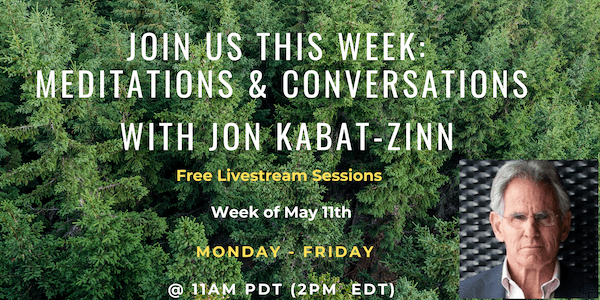
Mindfulness COVID-19 Retreat with Jon Kabat-Zinn: last week 22-26 June 2020!

Today we are starting the 13th week of the COVID-19 retreat with Jon Kabat-Zinn, a long and fascinating mindfulness journey across the continents in the age of the coronavirus epidemic. A very special week indeed, as this will be the last of the retreat in its current form that will end on Friday 26 June.

You can join us live every day of this week at11 am PDT for livestreams by registering at the following url: http://wisdom2conference.com/live

Photo by Anton Repponen on Unsplash

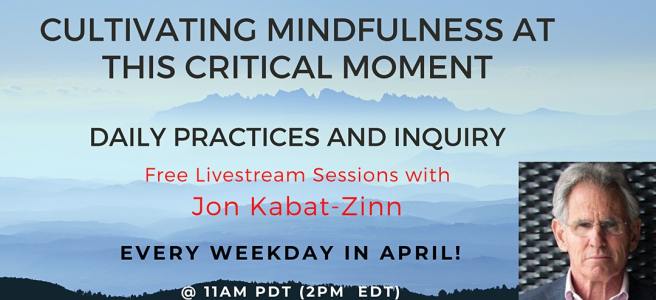
Cultivating mindfulness at this critical moment

The online Mindfulness retreat with Jon Kabat-Zinn has entered in its 7th week, providing a very useful and helpful window on here and now for anyone who is interested, or who is practicing mindfulness. It happens every week day at 7pm Lisbon Time, (8pm Paris or Brussels Time).

Two special features make this online retreat unique: the Q & A session with Jon after the guided meditation, and the community conversations that take place in the second hour on Tuesdays and Thursdays.

The Zoom connection allows for an audience of up to 1000 persons, if it is full when you connect, you can follow the session live on YouTube (see links on this page). You do not need to be already familiar with Mindfulness to try and to attend, this is an open retreat.

See hereunder the announcement and the instructions for connection. If you miss a session, you can watch it on YouTube on the webpage of the organisers.

Dear Friends,

We do not know how long these sessions will last, but we are so happy to continue them for the foreseeable future!

Join us each weekday at 11am PDT. This week we have the same links as last week. I have included them below. These are completely free, and you are welcome to invite invite friends and colleagues.

See you soon!

Ways to Join May 11th – 15th

Zoom Link: https://zoom.us/j/92482566387

(Limited to the first 1,000)

Join Online: www.wisdom2conference.com/live (No limit) You can also watch past sessions here.

Time: 11 AM PDT (2 PM EDT)

When: Daily Monday – Friday, April 27th – May 1st

Tuesday and Thursday, please stay on for community conversations following the session. Noon PDT. Link is www.wisdom2conference.com/group1

Between tragedies and statistics

I have found a very interesting analysis about the use of epidemiology and modelling for policy making in an article from The Economist published on Apr 4 with the title « The hard choices Covid policy makers face ».

This article is a good example of the importance to escape to the « noise » created by a maelström of messages, comments, opinions, true and fake data and other pseudo scientific evidence that come out of the media and from Internet. In those Covid-19 days, especially while being in lockdown during already 8 weeks, the most difficult is to avoid to be absorbed by such a flow that is highly unstable and unreliable, and that conveys contradictory messages that can only lead to a depressive state of mind and a feeling of absolute despair.

A significant part of this negative flow relates to « exit » or « Post-Covid » strategies, to the possible future waves (are we going for a second or a third one, is it going to happen in June, in the Summer, in the Autumn, etc.). But it does so in a way that does not bring any reflection, nor any orientation to figure out what are the key questions. In such condition it does not come as a surprise to see that the main result is an increase of the confusion about how to think our future. Therefore every time that I will find a paper, an article or a report that brings some food for thought, I will share it with you on this blog.

Why this briefing in particular? I find that it puts into perspective statistical modelling, other methods and approaches and their respective limitations, both from epidemiology and economics.

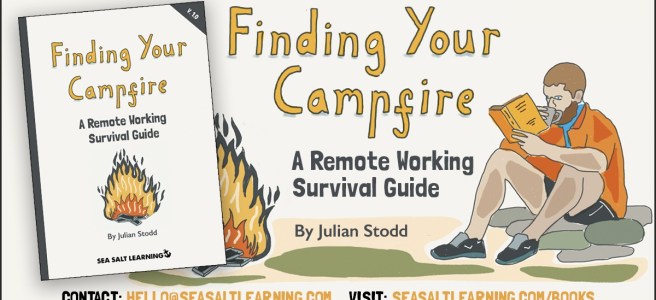
A Remote Working Survival Guide

Thanks to a suggestion from Marie-Christine, I discovered a very interesting survival guide written by Julian Stodd for those who dare to explore « the wilderness of remote work ».

The book is presenting in a very original and imaginative mode some general principles about remote working that encompass the situation created by the COVID-19 epidemic and the massive move to teleworking that has resulted, but that is not limited to this. In that sense it is not specific, it can be used by various kind of organisations in different contexts and this is why I find it very inspiring.

Indeed for many of us, for those organisations that did not really adopt remote working as a standard practice for their staff before, the change has been very fast and was largely improvised because of the situation. And if we are both surprised and very satisfied that it has been going so well given the conditions of that shift, it does not mean that we know what worked well and why.

This is why we need to make a critical review of what we do and how we do it, if we want to make conscious and rational choices for the future. And I find that the book, that I started reading today, is very interesting and gives the reader some food for thought that may be helpful for that purpose.

…And for the moment you can get the digital version of the book for free (click on the link to the article here!

Introduction

This short book is a survival guide for individuals, teams, and organisations thrust into a new way of remote working by the global coronavirus pandemic. It is not intended as a set of instructions, or a clear set of answers, but rather as a map with certain landmarks highlighted to indicate that we should take time to visit them on the journey. It is intended to give you a lens through which to see this challenge, and to take practical action.

Qi Gong: Eight pieces of brocade

I have discovered QI Gong and Tai Chi Chuan some 15 years ago in Lisbon, thanks to a small association called Academia de Artes Orientais. In the beginning of every lesson of Tai Chi, there was first a session of Qi Gong, and one of the key features was the practice of the « Eight pieces of brocade ». As the best moment for practice was the morning lesson, I discovered and enjoyed the benefits of a regular practice in the early morning. Then we moved our offices to another location in the city and it became more difficult for me to continue the practice, and I stopped until I rediscovered it some months ago.

The Eight Pieces of Brocade is an Ancient Chinese exercise & fitness Practice.  It is a popular form of Qi Gong, also known as Ba Duan Jin. It originated during the South Song Dynasty nearly 1000 years ago and it offers practices that are accessible for everyone, regardless of age or physical condition. In general, the first practices that students generally learn about are relaxation.

A few weeks ago, I discovered a fantastic video of 40 minutes of Qi Gong on YouTube that I have shared with you in a previous post, and that I follow 2-3 times a week. Today, I would like to share with you a shorter exercise, covering the Eight Pieces of Brocade that will take you only 20 minutes if the other one seems too long for you.

As you can see, there is no age for the practice of Qi Gong, I hope that like me you will appreciate the slow pace of the series of exercises and that it will help you to start well your day.

Méditation de la Pleine Conscience: comment « s’appliquer »? (en Français dans le texte…)

Photo by Christopher Burns on Unsplash

La pleine conscience est une expression désignant une attitude d’attention, de présence et de conscience vigilante, qui peut être interne (sensations, pensées, émotions, actions, motivations, etc.) ou externe (au monde environnant, bruits, objets, événements, etc.) (Wikipedia).

Pratique ancienne associée au bouddhisme, elle est devenue plus connue suite aux travaux du Dr Jon Kabat-Zinn aux Etats-Unis, qui a fondé et est le président actuel du Center for Mindfulness in Medicine, Health Care, and Society à l’université de l’école de médecine du Massachusetts. Il est également le fondateur (en 1979) et l’ancien directeur de la Stress Reduction Clinic (Clinique de réduction du stress), où il a développé entre autres un programme spécifique pour le traitement du stress basé sur la Méditation de Pleine Conscience, le Mindfulness-Based Stress Reduction Programme. Il s’agit d’un programme qui combine la méditation journalière et le Hatha Yoga.

C’est une pratique très utile et très facile, et qui rend de précieux services en ces temps de confinement et d’isolement, et du stress qui en résulte.

Il existe aujourd’hui de nombreux ouvrages en Français, dont voici quelques titres:

Il existe également de nombreuses séances de méditation guidée disponibles sur CD ou sur Internet, en particulier sur YouTube.

Depuis quelques années sont apparues des applications de Méditation de la Pleine Conscience, dont l’une d’entre elles se démarque par son grand succès: Mindfulness with Petit Bambou, qui comprend 8 modules de méditation gratuits, le reste du programme étant payant.

D’autres applications seront ajoutées dans les prochains jours après les avoir essayées nous-même.